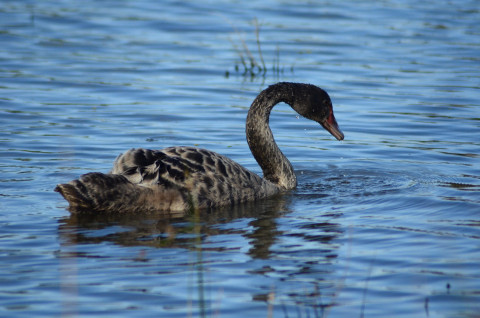
This much-loved group of birds (Cygnus atratus) love to feed on the longer grass in the median strip. This means they regularly waddle across busy Point Cook Rd, putting them at risk of car strike.
Thanks for not feeding the swans
As much as we enjoy feeding ducks and swans, it is never a good idea to feed them human food as it doesn’t meet their nutritional needs. Feeding bread to ducks and swans is like feeding them junk food, delicious but not nutritious.
It can also encourage them to leave the safety of their wetland home, increasing their chance of contact with threats such as pedestrians, dogs, and vehicles.
FAQs
Can the swans be relocated?
No. Swans are a native animal and so are protected under the Wildlife Act 1975, meaning it is illegal to relocate, harm, or interfere with the animal, their young, or nesting sites without a permit.
Relocating native animals is rarely successful. Wild animals often have specific habitat preferences, territorial behaviour, or are very good at moving freely through urban or rural landscapes. A relocated swan would likely fly straight back to its favourite wetland where it was removed from.
Can we fence the wetland?
Whilst fencing can be helpful in some situations, installation of fencing between the wetland and Point Cook Rd may increase the safety risk to the swans. If the swans were to find their way around the fence, they may not be able to quickly get back to the safety of the wetland if spooked by a pedestrian, dog, or vehicle. This could then result in them moving into oncoming traffic to avoid the threat rather than retreating to the wetland.
Fencing may also negatively impact other wildlife that occupy the same wetland. It is important that we reduce barriers to the free movement of wildlife where able.
Possible safe fencing options for around the wetland are still being explored in collaboration with Melbourne Water.
Can the median strip be mown?
Point Cook Rd, including the median strip, is managed by the Department of Transport and Planning (DTP). This means the mowing schedule for the Point Cook Rd median strip is less frequent than the Council managed open space and nature strips adjacent to the road. The longer grass on the median strip is unintentionally providing the swans with increased grass to feed on.
Higher spring rainfall and resource pressure on mowing teams mean that DTP contactors do not have capacity to increase mowing frequency on Point Cook Rd.
Did Council forget to mow around the wetland?
In coming weeks, you may notice long grass around the stormwater treatment wetland on the corner of Point Cook and Sneydes Rd. Council is establishing a ‘No-mow Swan Zone’ to allow the grass to grow longer with the hope it will provide a more appealing food source for the swans, reducing their need to cross Point Cook Rd.
Can you reduce the speed limit?
Point Cook Rd is under the management of the Department of Transport and Planning ) with road regulations dictating that the road speed in that location cannot be reduced. Local drivers however can choose to use additional caution when driving around the junction of Point Cook Rd and Sneydes Rd by lowering their speed in consideration of the swans in the area.