Wyndham City Council respectfully acknowledges the Bunurong and Wadawurrung Peoples as the Traditional Owners of the lands and waterways on which Wyndham stands.
The Wyndham area holds deep cultural, spiritual, and historical significance for Aboriginal communities and has been cared for by the Bunurong and Wadawurrung Peoples for tens of thousands of years. These Nations are part of the broader Kulin Nation, a cultural alliance of Aboriginal groups in south-eastern Victoria, each with their own distinct languages, traditions, and connections to Country.
Country is understood through enduring relationships to land, waters, seasons, and community. These connections continue to be strong and are expressed through cultural practices, knowledge sharing, and community life.
Today, Wyndham has one of the largest Aboriginal and Torres Strait Islander communities in Victoria.
Wyndam City is committed to recognising, respecting, and celebrating the living cultures, histories, and contributions of First Nations peoples, and to supporting ongoing reconciliation in our community.
For more information visit Victoria's Current Registered Aboriginal Parties.
The Kulin Nation
Some First Nations people believe that the term Kulin Nation is a European construct. The Kulin Nation refers to an alliance of five Aboriginal tribes in south central Victoria and has been largely used when there is an instance of contested land.
The collective traditional territory for the tribes of the Kulin Nation extends around Port Phillip and Western Port, up into the Great Dividing Range and the Loddon and Goulburn River valleys. The language groups were connected through shared moieties (divided groups) Bunjil (wedge-tailed eagle) and Waa (crow). Bunjil is the creation spirit of the Kulin and Waa the protector of the waterways.
Below is a listing of the language groups and the tribes associated with that language group.
· Woiwurrung (Woy-wur- rung) – The Wurundjeri People
· Boonrwrung (Bun-er- rung) – The Bunurong or Boon Wurrung People
· Wathaurrung (Wath-er- rung) – The Wathaurong People
· Daungwurrung (Tung-ger- rung) – TheTaungurong People
· Dja Dja Wrung (Jar-Jar wrung) – The Dja Dja Wurrung or Jaara People
Who are Traditional Owners?
Traditional Owners are Aboriginal and/or Torres Strait Islander people with family ties to a particular area, knowledge about traditions, observances, customs or beliefs associated with the area. They have responsibility under cultural lore for significant Aboriginal places located in, or significant Aboriginal objects originating from, this area. The Aboriginal Heritage Act 2006 recognises Traditional Owners “As the primary guardians, keepers and knowledge holders of Aboriginal Cultural Heritage”
The Traditional Owners of the lands along either side of the Werribee Yulluk (River) and across Wyndham are the Bunurong and Wadawurrung people.
Why is a Welcome to Country and Acknowledgement of Country Important?
An Acknowledgement of Country recognises that Wyndham has a strong and proud Aboriginal and Torres Strait Islander history dating back thousands of years. Ensuring that welcoming and acknowledgement protocols are included in meetings and official events shows respect and recognises Aboriginal and Torres Strait Islander people as the Traditional Custodians of the land. In Aboriginal and Torres Strait Islander cultures, the meaning of Country goes beyond ownership or connection to land.
What is the difference between Traditional Owners and Traditional Custodians?
These terms are used interchangeably. The word Owner reminds people that land was never formally ceded to anyone and of Australia’s history of denying ownership and Aboriginal people’s sovereignty over their lands. The word Custodian reminds people of the ongoing obligation to care for Country and that Aboriginal people don’t own the land, but it owns them.
Aboriginal people may prefer to refer to themselves as Custodians. State and Territory Governments will typically refer to Traditional Owners.
Who are the Registered Aboriginal Parties for the Wyndham region?
Registered Aboriginal Parties (RAPs) are representative corporations, inclusive of all Traditional Owners of an identified Country. More information can be found here.
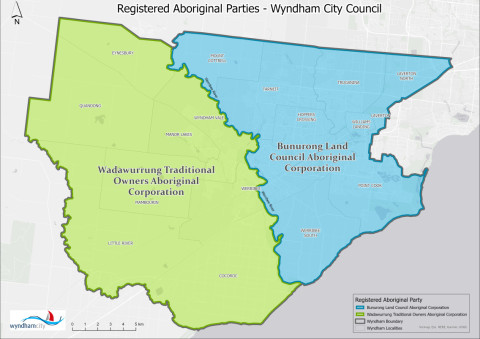
The Registered Aboriginal Parties in Wyndham are Bunurong Land Council Aboriginal Corporation and Wadawurrung Traditional Owners Aboriginal Corporation.
View a list of other Registered Aboriginal Parties around Victoria.
How do I respectfully acknowledge the Traditional Owners of Wyndham?
Bunurong – East of the Werribee River
If you are located on the eastern side of the Werribee River, the Bunurong people should be acknowledged. The Bunurong Land Council can be contacted to perform ceremonies, provide advice on cultural heritage matters and conduct business on behalf of the Bunurong people.
Example of Acknowledgement of Country Bunurong
We meet here today at (insert meeting place) and I would like to acknowledge the Bunurong people as the Traditional Custodians of this land. We also acknowledge their neighbours the Wadawurrung people. We pay respect to Ancestors and Elders who always have, and always will, care for Country and community today and for future generations.
Wadawurrung – West of the Werribee River
If you are located on the western side of the Werribee River you acknowledge the Wadawurrung people. Wadawurrung Traditional Owners Aboriginal Corporation. can be contacted to perform ceremonies, provide advice on cultural heritage matters and conduct business on behalf of the Wadawurrung people.
Example of Acknowledgement of Country Wadawurrung
We meet here today at (insert meeting place) and I would like to acknowledge the Wadawurrung people as the Traditional Custodians of this land. We also acknowledge their neighbours the Bunurong people. We pay respect to Ancestors and Elders who always have, and always will, care for Country and community today and for future generations.
Example - Acknowledgement of Country Bunurong & Wadawurrung
I would like to acknowledge the Bunurong and Wadawurrung people as Traditional Custodians of the lands on which Wyndham is being built. I pay respect to Ancestors and Elders who always have, and always will, care for Country and community today and for future generations.
I acknowledge any Aboriginal and Torres Strait Islander people who live in this tradition and call us to shared responsibility. May our words and actions lead us to respect Country, learn from Elders and practice creative wisdom for future generations.
If you are unsure of whom to acknowledge you can always pay respect to the local Aboriginal community by acknowledging “the Traditional Owners of the land on which we meet.”
Difference between Acknowledgment of Country and a Welcome to Country?
First Peoples in Australia are the oldest continuing cultures on Earth. A central part of these cultures are Welcomes to Country and Acknowledgements of Country. Both Welcomes and Acknowledgements recognise the complex ownership and land stewardship that existed before colonisation and continues to this day.
A Welcome to Country can only be delivered by a Traditional Owner on their Traditional Country. The ceremony formally welcomes visitors to ancestral lands and acknowledges continuous cultural connection to the area.
An Acknowledgement of Country can be delivered by anyone and is about paying respects to the Elders, Traditional Owners and the Country on which you are speaking. This practice shows respect and acknowledges First Peoples long standing practices and connection to Country.
Where can I go to access further information about the local Aboriginal people and tribes of the Wyndham region?
It is important to remember that there is a wide diversity of Aboriginal people living in any Australian community. To build a better understanding of Wyndham’s Aboriginal community a good starting place could be researching the Kulin Nation and the tribes associated with that.
The Wyndham Libraries website has information about Wyndham’s Aboriginal past and history. The local government website Maggolee - Here in this Place, Local Government and Aboriginal Communities Working Together has useful content. You can also utilise the number of links on this page to some Aboriginal organisations for further information. The Census website may be another useful site.
Does Wyndham have any Cultural Heritage Officers?
In line with the current development of the new 2023 - 2025 Reconciliation Action Plan, this is currently under review. Cultural Heritage is managed by Council’s Planning, Building & Health Department. Aboriginal Cultural Heritage matters are contracted to Aboriginal organisations and contractors.
Related sites
Bonmarart Leewik - Resource - stories of people, places & events that have helped shape the Western Suburbs Aboriginal Community
**The word tribe has been used to describe a group of Aboriginal people. Aboriginal language is known to not be recorded in the written word sense. Words from the English language have an English definition/meaning/translation as defined in a dictionary and they are not traditional in an Aboriginal cultural sense, including the word tribe. For the point of this exercise the word tribe has been used in the absence of a more suitable substitute**